Pattern: Bordered Chevron Blanket

Finished Measurements:
46" x 68"

Materials:
Size 9 (US) circular needle
(BC) 2 skeins Loops & Threads Impeccable in Aran
(CC) 3 skeins Lang Yarns Mille Colori Big in Color No. 0044 (pink and green blend)
(MC) 4 skeins Land Yarns Mille Colori Big in Color No. 0039 (brown and orange blend)

Abbreviations:
K - knit
P - purl
Yo - yarn over
Sl - slip next stitch
Psso - pass the slipped stitch over the stitch just worked
St(s) - stitch(es)

Chevron Pattern:
Row 1: *K1, yo, K12, K2tog, sl 1, K1, psso, K12, yo.* Repeat from * to * until last st, K1.
Row 2: P across.
Instructions:
This blanket will test your intarsia skills. If you've never worked with color changes before, I posted some instructions here but I found these instructions were helpful as well.

You'll have seven different color sections, each bordered by white. Each section has its own ball of yarn. Conveniently, you'll have four sections of MC to match the 4 skeins you'll use and three sections of CC to match the 3 skeins you'll use. There are 8 border sections of BC so you'll want to make 8 relatively small balls of BC yarn. You'll be working from a lot of different skeins and it'll get tangled a lot, but don't get frustrated! The finished product is worth it.

In BC, CO 204 stitches
Row 1-6: Work Chevron Pattern.

Now you change colors, which are ordered across a row as follows:
BC, MC, BC, CC, BC, MC, BC, CC, BC, MC, BC, CC, BC, MC, BC

Row 7: (In BC, K1, yo, K1), *(In MC, K11, K2tog, sl 1, K1, psso, K11), (In BC, K1, yo, K1, yo, K1), (In CC, K11, K2tog, sl 1, K1, psso, K11), (In BC, K1, yo, K1, yo, K1).* Repeat from * to * until last 28 sts, in MC, K11, K2tog, sl 1, K1, psso, K11, in BC, K1, yo, K1.

Row 8: P across

Repeat Rows 7 and 8, 9 more times for a total of 10 repeats (making 20 Rows total).

Rows 9-12: In BC, work Chevron Pattern.

TIP: When changing from working the BC only across to working the different colors across, be sure you are pulling from the same skein in that section below to keep the color changing consistent.

Repeat Rows 7-12, 9 more times (10 times total)

Work Rows 7-8 one more time.

Rows 13-18: In BC, work Chevron Pattern. Bind off.


Find me on Instagram and tag me in your photos! I'd love to see your work. @knitabitcrochetaway

Pattern: Quatrefoil Reversible Slipper Socks

I wanted to make some reversible slipper socks that were also really warm so I decided to try making these socks using double knitting. It was quite challenging to figure out parts of the sock using double knitting, especially the toe at the very beginning, so I recommend tackling this pattern only if you have sock experience and double knitting experience. This could be a fun pattern to try as your first double knitting project, but it could be a bit frustrating, so beware! There's a great photo tutorial on double knitting available here. I tried my best to explain my process as a helpful guide.

Finished Measurements:
Pattern written for women's size 8 (US) socks, but it's easily adaptable to fit other sizes. If you want to make the foot wider or narrower, then increase or decrease until you get your size and follow the pattern chart to keep the quatrefoil looking the same.

These socks are meant to be slipper socks, so they won't fit snug on your foot like normal socks. They're a bit looser for around-the-house comfort.

Materials:
Size 1 double pointed needles
1 skein Lion Brand Sock-Ease in Marshmallow
1 skein Lion Brand Sock-Ease in Snow Cone

Abbreviations:
K - knit
P - purl
Sl - slip unworked stitch from left needle to right needle
SSK - slip unworked stitch from left needle to right needle knitwise. Slip a second unworked stitch from the left needle to the right needle knitwise. Slip those two unworked stitches separately back to the left needle purlwise. Knit those two stitches together in the back of the stitches (decrease).
K2tog - knit two stitches together (decrease). Be sure to use double knitting decrease method, available here.
P2tog - purl two stitches together (decrease). Be sure to use double knitting decrease method, available here.
K Inc - knit into the front and back of the same stitch (increase).
P Inc - purl into the front and back of the same stitch (increase).
W - white
B - blue

Instructions:
Toe Shaping
Using provisional cast on method, cast on 12 stitches of each color, making 24 stitches total on your needle. This part is really tricky and will probably require a lot of trial and error until you get the hang of it.

To have a white toe on the outside and a blue toe on the inside, start with a blue on the needle, but don't make one blue around the string. Then, continue as normal under the provisional cast on method with the white, then the blue. Continue alternating colors and end with one white on the needle, but don't make one white around the string. This keeps the alternating colors as you pick up the live stitches from the string.

Remove live stitches from scrap yarn and split them across two double pointed needles. Split the stitches on the other needle across two needles, having four needles in total with 6 stitches of each color per needle (12 stitches total per needle). Begin knitting in the round.

Round 1: Needle 1 - K1 W, P1 B, K1 W, P1 B, K Inc W, P Inc B, *K1 W, P1 B,* repeat from * to * until end of needle.
          Needle 2 - *K1 W, P1 B,* repeat from * to * until last 4 sts, K Inc W, P Inc B, K1 W, P1 B, K1 W, P1 B.
          Needle 3 - K1 W, P1 B, K1 W, P1 B, K Inc W, P Inc B, *K1 W, P1 B,* repeat from * to * until end of needle.
          Needle 4 - *K1 W, P1 B,* repeat from * to * until last 4 sts, K Inc W, P Inc B, K1 W, P1 B, K1 W, P1 B.

Rounds 2-5: Repeat Round 1.

Round 6: *K1 W, P1 B,* repeat from * to * until end.
Round 7: Repeat Round 1.
Round 8: Repeat Round 6.
Round 9: Repeat Round 1.
Round 10: Repeat Round 6.
Round 11: Repeat Round 1.
Rounds 12-13: Repeat Round 6.
Round 14: Repeat Round 1.
Rounds 15-16: Repeat Round 6.
Round 17: Repeat Round 1.
Rounds 18-20: Repeat Round 6.
Round 21: Repeat Round 1.
Rounds 22-25: Repeat Round 6. (136 stitches total, 68 sts in each color)

Foot:
Change your yarn so the main color on the outside is blue with white as a contrast color, making the inside with a white main color and blue contrast color. Work the pattern based on the quatrefoil chart below:

Work until you have three quatrefoil rows on the foot, or until the sock is the length from the toe to the bend of your ankle at the top of your foot.

Heel Flap:
Turn so WS is facing and Work Needles 3 and 4 ONLY
Leave Needles 1 and 2 unworked 

Row 26: Holding yarn to the front, sl1, holding yarn to the back, sl1, *P1 W, K1 B,* repeat from * to * until end. 
Row 27: Holding yarn to the back, sl1, holding yarn to the front, sl1, *K1 B, P1 W* repeat from * to * until end. 
Repeat Rows 26 and 27, 11 more times (12 repeats total, 24 rows total).

Heel Shaping:
There are really great instructions on how to decrease while double knitting here.

Row 28: Holding yarn to the front, sl1, holding yarn to the back, sl1, *P1 W, K1 B* repeat 17 more times (18 times total), P2tog (of white using double knitting decrease method), K2tog (of blue using double knitting decrease method), P1 W, K1 B, turn. Leave remaining sts unworked. Continue in this manner.
Row 29: Holding yarn to the back, sl1, holding yarn to the front, sl1, *K1 B, P1 W* repeat 2 more times (3 times total), K2tog, P2tog, K1 B, P1 W, turn. 
Row 30: Holding yarn to the front, sl1, holding yarn to the back, sl1, *P1 W, K1 B* repeat 3 more times (4 times total), P2tog, K2tog, P1 W, K1 B, turn. 
Row 31: Holding yarn to the back, sl1, holding yarn to the front, sl1, *K1 B, P1 W* repeat 4 more times (5 times total), K2tog, P2tog, K1 B, P1 W, turn. 
Row 32: Holding yarn to the front, sl1, holding yarn to the back, sl1, *P1 W, K1 B* repeat 5 more times (6 times total), P2tog, K2tog, P1 W, K1 B, turn. 
Row 33: Holding yarn to the back, sl1, holding yarn to the front, sl1, *K1 B, P1 W* repeat 6 more times (7 times total), K2tog, P2tog, K1 B, P1 W, turn. 
Row 34: Holding yarn to the front, sl1, holding yarn to the back, sl1, *P1 W, K1 B* repeat 7 more times (8 times total), P2tog, K2tog, P1 W, K1 B, turn. 
Row 35: Holding yarn to the back, sl1, holding yarn to the front, sl1, *K1 B, P1 W* repeat 8 more times (9 times total), K2tog, P2tog, K1 B, P1 W, turn. 
Row 36: Holding yarn to the front, sl1, holding yarn to the back, sl1, *P1 W, K1 B* repeat 9 more times (10 times total), P2tog, K2tog, P1 W, K1 B, turn. 
Row 37: Holding yarn to the back, sl1, holding yarn to the front, sl1, *K1 B, P1 W* repeat 10 more times (11 times total), K2tog, P2tog, K1 B, P1 W, turn. 
Row 38: Holding yarn to the front, sl1, holding yarn to the back, sl1, *P1 W, K1 B* repeat 11 more times (12 times total), P2tog, K2tog, P1 W, K1 B, turn. 
Row 39: Holding yarn to the back, sl1, holding yarn to the front, sl1, *K1 B, P1 W* repeat 12 more times (13 times total), K2tog, P2tog, K1 B, P1 W, turn. 
Row 40: Holding yarn to the front, sl1, holding yarn to the back, sl1, *P1 W, K1 B* repeat 13 more times (14 times total), P2tog, K2tog, P1 W, K1 B, turn. 
Row 41: Holding yarn to the back, sl1, holding yarn to the front, sl1, *K1 B, P1 W* repeat 14 more times (15 times total), K2tog, P2tog, K1 B, P1 W, turn. 
Row 42: Holding yarn to the front, sl1, holding yarn to the back, sl1, *P1 W, K1 B* repeat 15 more times (16 times total), P2tog, K2tog, turn. 
Row 43: Holding yarn to the back, sl1, holding yarn to the front, sl1, *K1 B, P1 W* repeat 15 more times (16 times total), K2tog, P2tog, turn. 
Row 44: Holding yarn to the front, sl1, holding yarn to the back, sl1, *P1 W, K1 B* repeat 15 more times (16 times total), P2tog, K2tog, P1 W, K1 B, turn. 

Begin working in the round again. 

Row 45: work across heel flap, pick up 12 white stitches from the outside (blue) and 12 stitches from the inside (white), alternating in the same manner as you have been, and K the blue sts and P the white sts. Work in the quatrefoil pattern across the next 2 needles. Pick up and work 12 white stitches and 12 blue stitches in the same manner across the other side of the heel flap. On the same needle, split the heel flap sts evenly between the needles with the picked up heel flap sts, working 18 sts on one needle and 18 sts on the other.

Gusset Shaping:
Round 46: Needle 1 - Work in Quatrefoil pattern.
       Needle 2 - Work in Quatrefoil pattern.
       Needle 3 - K1 B, P1 W, SSK (keeping with double knitting decrease method), P2tog, *K1 B, P1 W,* repeat from * to * until end.
       Needle 4 - *K1 B, P1 W,* repeat from * to * until last 6 sts, K2tog (keeping with double knitting decrease method), P2tog, K1 B, P1 W.

Round 47: Needle 1 - Work in Quatrefoil pattern.
       Needle 2 - Work in Quatrefoil pattern.
       Needle 3 - *K1 B, P1 W,* repeat from * to * until end.
       Needle 4 - *K1 B, P1 W,* repeat from * to * until end.

Repeat Round 46 and Round 47 until there are 34 sts per needle.


Ankle:
Continue working the Quatrefoil pattern across all needles until you reach approximately an inch less than your desired length. I worked two quatrefoil rows above the heel.

Ribbing:
Ribbing with double knitting can be tricky because you need to change where you hold the yarn for each stitch differently than you have been doing. Work these same repeating four sts across the round for as many rounds until you reach your desired length, approximately one inch:
With both yarns at the back, K1 W
With W yarn at the front and B yarn at the back, K1 B
With W yarn at the front and B yarn at the back, P1 W
With both yarns at the front, P1 B

Goldenrod Tank

Materials:
Size 6 circular needle
2 skeins Ice Yarns Cotton Elite in Gold
Sewing needle
Instructions:
Sorry, I don't have a link to this pattern. It's published in the Love of Knitting, Summer 2014 magazine and designed by Marly Bird. I'm not usually one to subscribe to knitting/crocheting magazines, but I got an offer to try out the mag for free. When I think magazine, I think of something that's heavy on the ads and lighter on the content. I didn't want to pay for something that was trying to sell me knitting products most of the time.

I was pleasantly surprised with this magazine, though. It was filled with 25 patterns and has only one or two ads in the front and back. They are all summer oriented and came in a good variety, ranging from tanks and beach cover ups to beachy table settings. I'm still looking through the patterns so I don't think I'll be subscribing anytime soon. I like the summer issue the best, too, because it's much harder to find pretty and lightweight patterns.
If you're looking to subscribe to a magazine with lots of different knitting patterns, this one is a pretty great find!

I stuck to the pattern in the magazine for the most part. The only alteration I made was to pick up double the amount of stitches on the sleeve edging than it called for. When I followed the pattern, the arm holes were uncomfortably tight.

Pattern: Wavy Cable Rib Toe Up Socks

I was inspired to make these socks by New Stitch A Day's wavy rib stitch. Jazz up your basic ribbed socks by adding a bit of cabling.

Finished Measurements:
Pattern written for women's size 8 (US) socks, but it's easily adaptable to fit other sizes. If you want to make the foot wider or narrower, then increase until you have a multiple of 3 sts plus 2.

Materials:
Size 1 double pointed needles
2 skeins Sensations Soles & More in Green/Blue
Cable hook, or if you're feeling adventurous, I recommend watching this video to learn how to cable without the hook. It's really convenient for knitting on the go with limited supplies, especially with this pattern where you're only holding one stitch to the front or back.

Abbreviations:
K - knit
P - purl
Sl - slip unworked stitch from left needle to right needle
SSK - slip unworked stitch from left needle to right needle knitwise. Slip a second unworked stitch from the left needle to the right needle knitwise. Slip those two unworked stitches separately back to the left needle purlwise. Knit those two stitches together in the back of the stitches (decrease).
K2tog - knit two stitches together (decrease).
P2tog - purl two stitches together (decrease).
Inc - knit into the front and back of the same stitch (increase).
Cn - cable needle
C2F - slip one stitch onto cn and hold to the front, K1, K1 from cn
C2B - slip one stitch onto cn and hold to the back, K1, K1 from cn
Wavy Cable Rib Pattern:
This pattern repeats throughout the sock, working it around the entire sock at the ankle and above, but only the top of the foot. (Stepping on cable bumps can be quite uncomfortable!)

Row 1: P2, *K2, P1.* Repeat from * to * until end.
Row 2: P2, *C2F, P1.* Repeat from * to * until end.
Row 3: P2, *K2, P1.* Repeat from * to * until end.
Row 4: P2, *C2B, P1.* Repeat from * to * until end.


Instructions:
Toe Shaping
Using provisional cast on method, cast on 8 stitches
Round 1: P across
Round 2: K across
Round 3: P across
Round 4: K across

Remove live stitches from scrap yarn and place them on a double pointed needle. You should have 16 sts on two needles (8 sts per needle). Begin knitting in the round.

Round 5: *K2, Inc, K1 (add a needle) K1, Inc, K2.* Repeat from * to * (12 sts)

Round 6: Needle 1 - K2, Inc, K across needle
          Needle 2 - K across needle to last 3 sts, Inc, K2
          Needle 3 - K2, Inc, K across needle
          Needle 4 - K across needle to last 3 sts, Inc, K2

Repeat Round 6 until you have 32 sts total (8 sts per needle)


Round 7: K across
Round 8: Needle 1 - K2, Inc, K across needle
        Needle 2 - K across needle to last 3 sts, Inc, K2
        Needle 3 - K2, Inc, K across needle
        Needle 4 - K across needle to last 3 sts, Inc, K2

Repeat Round 7 and Round 8 until you have 64 sts total (16 sts per needle)


Foot:
For all foot rounds, work the Wavy Cable Rib Pattern across Needles 1 and 2 and work the stockinette stitch across Needles 3 and 4. In other words, you will work the cable pattern over the top of the foot and stockinette stitch over the bottom of the foot.

Work until the sock is the length from the toe to the bend of your ankle at the top of your foot.
Heel Flap:
Turn so WS is facing and Work Needles 3 and 4 ONLY (31 sts)
Leave Needles 1 and 2 unworked 

Row 9: Sl1, P across.

Row 10: Sl1, K across.
Repeat Rows 9 and 10, 11 more times (12 repeats total, 24 rows total).

Heel Shaping:
Row 11: Sl1, P16, P2tog, P1, turn. Leave remaining sts unworked. Continue in this manner.
Row 12: Sl1, K3, K2tog, K1, turn. 
Row 13: Sl1, P4, P2tog, P1, turn. 
Row 14: Sl1, K5, K2tog, K1, turn. 
Row 15: Sl1, P6, P2tog, P1, turn. 
Row 16: Sl1, K7, K2tog, K1, turn. 
Row 17: Sl1, P8, P2tog, P1, turn. 
Row 18: Sl1, K9, K2tog, K1, turn. 
Row 19: Sl1, P10, P2tog, P1, turn. 
Row 20: Sl1, K11, K2tog, K1, turn. 
Row 21: Sl1, P12, P2tog, P1, turn. 
Row 22: Sl1, K13, K2tog, K1, turn. 
Row 23: Sl1, P14, P2tog, P1, turn. 
Row 24: Sl1, K15, K2tog, turn.
Row 25: Sl 1, P15, P2tog, turn.

Begin working in the round again. 
Row 26: K across heel flap, pick up and K 12 sts along first side of the heel. Work in Wavy Cable Rib Pattern across the two needles left unworked during the heel flap. Pick up and K 12 sts along second side of the heel. On the same needle, K 8 sts from the heel flap, leaving 9 heel flap stitches, splitting the sts from the heel flap between the two needles with the picked up sts. The needle starting with the 9 heel flap stitches is now the start of the round.

Gusset Shaping (decrease)
Round 27: Needle 1 - K across until last 3 sts, K2tog, K1.
       Needle 2 - Work in Wavy Cable Rib Pattern.
       Needle 3 - Work in Wavy Cable Rib Pattern.
       Needle 4 - K1, SSK, K across.

Round 28: Needle 1 - K across.
       Needle 2 - Work in Wavy Cable Rib Pattern.
       Needle 3 - Work in Wavy Cable Rib Pattern.
       Needle 4 - K across.

Repeat Round 27 and Round 28 until there are 64 sts total (16 sts per needle).

Ankle
Continue working the Wavy Cable Rib Pattern across all needles until you reach approximately an inch less than your desired length.

Ribbing
K1, P1 across for about an inch.
Cast off. Enjoy!

Shetland Trip

I was once again invited to tutor a knitting workshop in Shetland with Arena Travel back in May. Ive been home a few weeks now, but keep thinking about what a fabulous time we had!

I adore Shetland and couldn't wait to get there this year, especially after the disappointment last year when the trip was abandoned due to bad weather. I went with a group of 14 knitters and our tour guide Caroline and we had good weather pretty much the whole time this year and only had a few drops of rain towards the end of our stay, the rest of the time it was dry, warm and bright.

We had a packed schedule and first on the agenda was a morning knitting workshop where I revealed the project for the week which was a fair isle and lace bag. The aim of the first workshop was to introduce participants to the 2 handed fair isle method.


In the afternoon we visited the Jamieson & Smith HQ in Lerwick where we were given a presentation by Director Oliver Henry. Oliver told us about how the fleeces are graded and how the yarn is produced. We were shown the lovely new yarn called 'Shetland Heritage' which we all fell in love with. Its really soft and comes in 11 traditional Shetland shades.


We spent rather a lot of time in the Jamieson & Smith shop where they had all their amazing yarns and patterns on display and for sale. Everyone had a lovely time looking at all the shades and we all did a little retail therapy!

We spent our second day at the Shetland Museum Archives where we were shown round the knitting and spinning areas with a guide. We were lucky enough to be given a spinning and knitting demo and a few of the group had a go at using the traditional knitting needles and knitting belt.


We spent some time in the afternoon at the Shetland Textile museum where we met the fastest knitter in the world Hazel Tindall and did a little more retail therapy. I bought this lovely fair isle chicken made by Polecraft


We had a full day workshop on Sunday - some of the group went on a boat trip for part of the day and they saw lots of wildlife and birds, including puffins and seals, although we could walk down and see the seals on the beach near the hotel any time we wanted. The scenery on Shetland is just beautiful and I'm not sure I've ever been to anywhere that the views have me quite so enthralled, watching the sun and shadows of the clouds on the sea and the land is mesmerising - and it doesn't really get very dark in the summer time so even at night there is a light on the horizon.


On our final day we had a lace workshop and we also made some dorset buttons which are always good fun to do. The image below shows the lace trim for the bag being blocked. I always soak my knitted pieces for a while before I put them together - soaking makes a massive difference to wool in particular and is in my view imperative to a good finish.


We spent our final afternoon visiting some local studios and touring the island a little. We had a lovely visit to Shetland Handspun where Elizabeth talked us through her spinning process and showed us her beautiful hand knits.


We also visited Neilanell's studio shop. I bought 2 pieces from her collection last time I visited Shetland and had promised myself not to buy anything new, but in the end I couldn't resist - Neilanell's designs are just so gorgeous, Im not sure that any of us left the store without a purchase!


As with all the Arena tours its always sad when it's time to go home, but we had an amazing trip and made some great friends. We also ate some wonderful food in the bistro at the hotel and I came home a good few pounds heavier, but my wallet was definitely lighter so at least there was balance!

If you fancy coming on an Arena tour, the next one I will be tutoring will be to Norway in March next year. You can find more information here


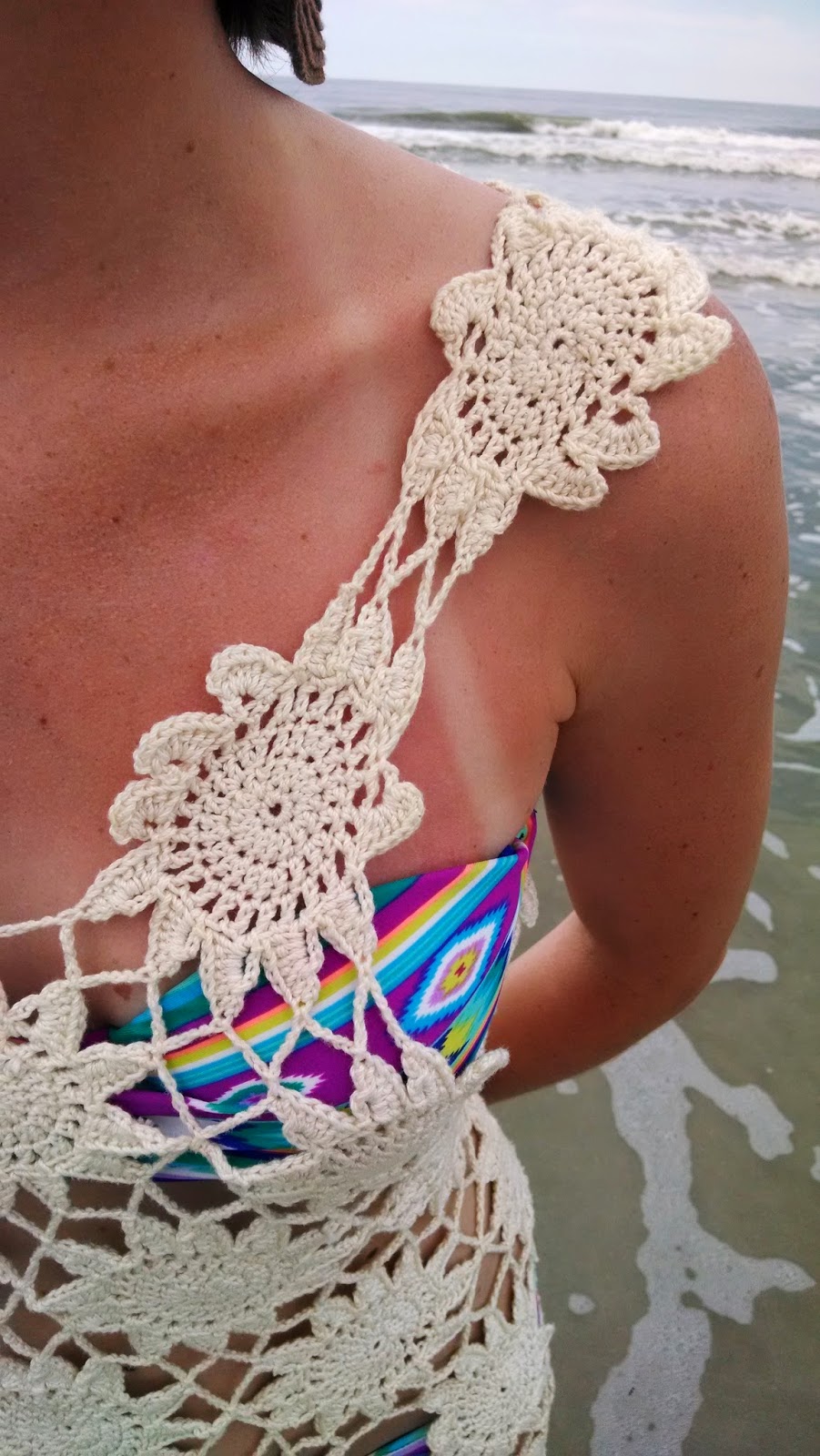
Pattern: Trailing Flowers Beach Cover Up

This crochet beach cover up is perfect for your next trip to the beach. Think of this as a pattern recipe to make a cover up that fits your body as snug or loose as you want.

The bottom of the cover up has alternating green and orange flowers with these colored flowers trailing up the spine. The piece is worked from the bottom up.


Note: when counting the flower petals in this pattern, work clockwise.


Materials:

6 skeins Aunt Lydia’s Crochet Thread, Fashion 3, in Natural
1 skein Aunt Lydia’s Crochet Thread, Fashion 3, in Copper Mist
1 skein Aunt Lydia’s Crochet Thread, Fashion 3, in Sage
Size D crochet hook

Finished Measurements:

34" long
Snugly fits a women's size small

Instructions:

Spine
Work the flowers for the spine first. 

Using magic loop method, 8 sc.
Round 1: Ch 3 (counts as 1 dc), 1 dc in first st, 2 dc in each st across the next 6 sts, turn (14 sts total).
Round 2: Ch 4, *1 dc in next st, 1 ch.* Repeat from * to * until end, turn.
Round 3: Ch 3, *1 dc in next st from Round 2, ch 3, 6 dc down the 1 dc from this Round, sl st in next st from Round 2.* Repeat from * to * until 4 more times (5 petals total), ch 8, sl st in starting ch from previous Round.

Rounds 1-3 completes one half flower. The final ch 8 from Round 3 makes up the magic loop starting round for the rest of the half flowers so they are attached.

Work one half flower in green, then work the next half flower in orange. The finished product has all orange flowers on one side and all green flowers on the other side. Continue working the flowers until you reach your desired length. Mine uses 20 spine flowers total. 

The top of the flowers will rest between your shoulder blades and the bottom will rest approximately 2.5" from the end of the piece. There will be an additional edge on the bottom.

Bottom Edging
The bottom edge flowers alternate green and orange, but make a full circle with the petals, as opposed to a half circle of petals with the flowers trailing up the spine. Written instructions are below:

Round 1: Using magic loop method, 8 sc

Round 2: Ch 3 (counts as first dc), 1 dc in next st, 2 dc in next st and in each st until the end, sl st to join. (16 sts total)
Round 3: Ch 4, dc in next st, *ch 1, dc in next st,* repeat from * to * until end, ch 1, sl st to join.
Round 4: Make petal the same as in the spine flowers and continue until you have 8 petals total.

For my size, I made 13 flower motifs. To join, attach the first petal of one flower to the sixth petal of a second flower, and attach the second petal of that same one flower to the fifth petal of the second flower. This leaves two petals unattached on the top and two petals unattached on the bottom of each flower.


To join the bottom edge to the trailing spine of flowers, join the third petal of one bottom edge flower to the bottom petal of the first flower in the spine.

Body Flower Motifs
The flowers on the body are white and are one round larger than the bottom edging flowers.

Round 1: Using magic loop method, 8 sc
Round 2: Ch 3 (counts as first dc), 1 dc in next st, 2 dc in next st and in each st until the end, sl st to join. (16 sts total)
Round 3: Ch 3 (counts as first dc), 1 dc in first st, *1 dc in next st, 2 dc in next st,* repeat from * to * until end, 1 dc in last st, sl st to join. (24 sts total)
Round 4: Ch 4 (counts as first dc and first ch), dc in next st, *ch 1, dc in next st,* repeat until end, ch 1, sl st to join.
Round 5: Make petal the same as in the spine flowers and continue until you have 12 petals total.

Body Motif Joining

To attach the flowers on the body, work 5 ch between a petal of one flower and a petal of a second flower.

Starting with the bottom edging flowers, sl st in third petal of edging flower (also the same flower with joined spine flowers), ch 5, sl st in fourth petal of edging flower, ch 5, sl st in joined petals of two flowers, ch 5, sl st in third petal of next flower, ch 5, join to first petal of white body flower, ch 5, sl st in fourth petal of edge flower.


Continue joining body flowers to edge flowers in this manner by working 3 sections of 5chs and sl st in next petal before attaching another body flower. For the 13 edge flowers, I attached 9 body flowers.

To join one row of body flowers to another row of body flowers, sl st in fifth petal of bottom row body flower, ch 5, sl st in eleventh petal of body flower in top row, ch 5, sl st in sixth petal of bottom row body flower, ch 5, sl st in tenth petal of top row body flower, ch 5, sl st in seventh petal of bottom row body flower, ch 5, sl st in third petal of next top row body flower, ch 5, sl st in eighth petal of bottom row body flower, ch 5, sl st in second petal of top row body flower, ch 5, sl st in ninth petal of bottom row body flower, ch 5, sl st in first petal of top row body flower, ch 5.

Continue attaching the body flowers in the same manner. Attach the body flower rows to the spine flowers as you go. The height of one row of body flowers is equal to the height of one green spine flower and one orange spine flower.


To add a little shape, decrease by one body flower motif as you go up the rows. 

Row 1 of body flowers: 9 motifs
Row 2 of body flowers: 8 motifs
Row 3 of body flowers: 7 motifs
Row 4 of body flowers: 6 motifs
Row 5 of body flowers: 6 motifs
Row 6 of body flowers: 6 motifs - this row will make up the bottom of the armholes. 
Row 7: attach one body flower motif on either side of the spine flowers. Attach three body flower motifs in the same row to the four front body motifs of the sixth row. Do not attach the motifs on either side of the spine to the front three motifs.

Row 8 (back shoulder): working in the back only, attach one motif on either side of the spine. Work a half flower for either side of the shoulder in the same manner as the spine motifs, but with an additional row like the body motifs to they are larger (6 petals total).


Row 9 (front shoulder): working in the front only, work one body flower motif on either shoulder and attach to Row 8.


Notice how there is a gap between the flower motifs in a row between the fourth petal of one flower and the tenth petal of another flower. You can either leave this gap open or you can close it by doing the following:


Ch 4 between the tenth petal of the first flower and the fourth petal of the second flower. Sl st in ninth petal of first flower, ch 5, sl st in ch 4 space, ch 5, sl st in fifth petal of second flower. Sl st in eleventh petal of first flower, ch 5, sl st in ch 4 space, ch 5, sl st in third petal of second flower.


I left the gap on the third row of body flowers, around where the stomach is, but filled in the gap on all other rows.


Good luck and enjoy! Please let me know if you have any questions. I may try to make a chart to make it easier to explain.


Find me on Instagram and tag me in your photos! I'd love to see your work. @knitabitcrochetaway